Project
Chalisée Naamani. Wardrobe
The artist unveils a previously unseen work in Bologna, merging performance and installation
Arte Fiera and Fondazione Furla renew their collaboration for the live performance program curated by Bruna Roccasalva, Artistic Director of the Foundation.
After the projects by Public Movement (2023), Daniela Ortiz (2024), and Adelaide Cioni (2025), the 2026 edition will feature Chalisée Naamani (1995, Neuilly-sur-Seine, Francia), who presents Wardrobe, a new work that weaves together performance, sculpture, and installation.
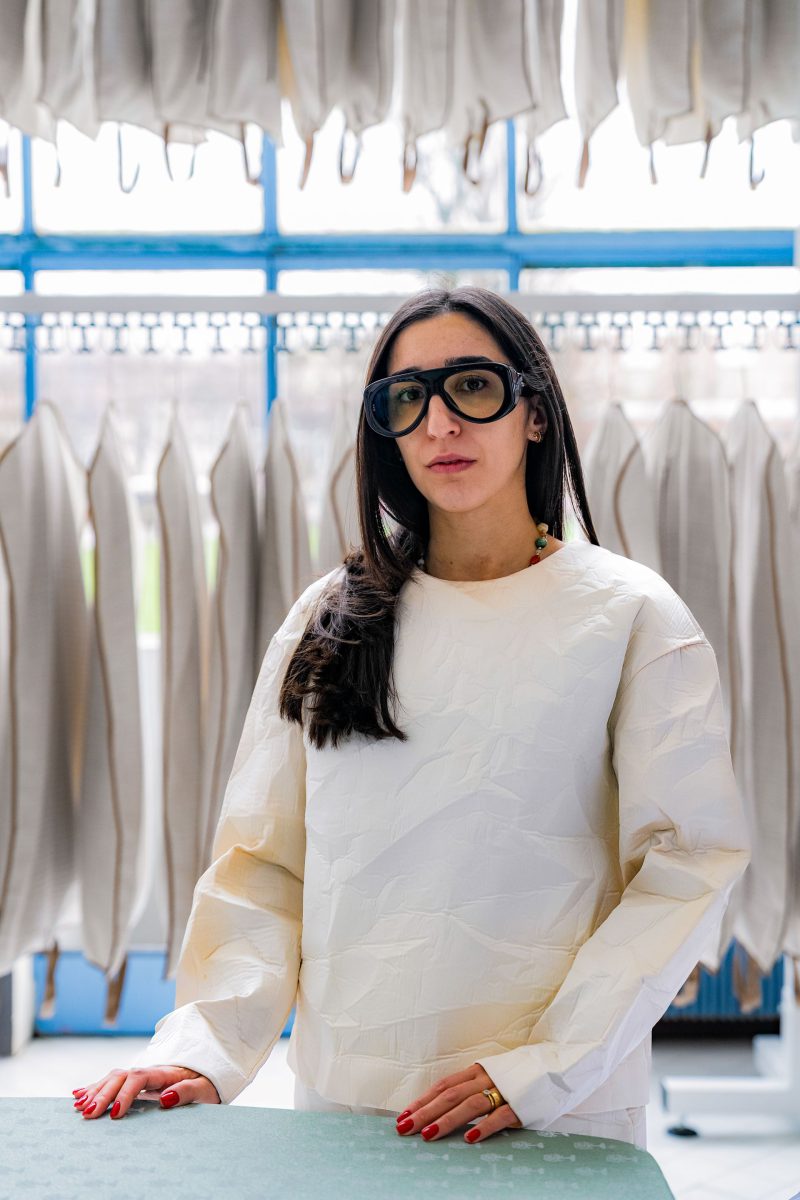
Chalisée Naamani employs an interdisciplinary approach that utilizes painting, sculpture, fashion, and technology, combining heterogenous styles and materials. Her research explores processes for construction of identity and methods for representation of the body in contemporary visual culture, moving among mainstream culture, references to art history, and autobiography. Her works, often created by assembling recycled materials and fabrics printed with images from her constantly expanding personal archive, take the form of vêtements-images (image-garments) conceived as paintings or sculptures, and therefore not meant to be worn.
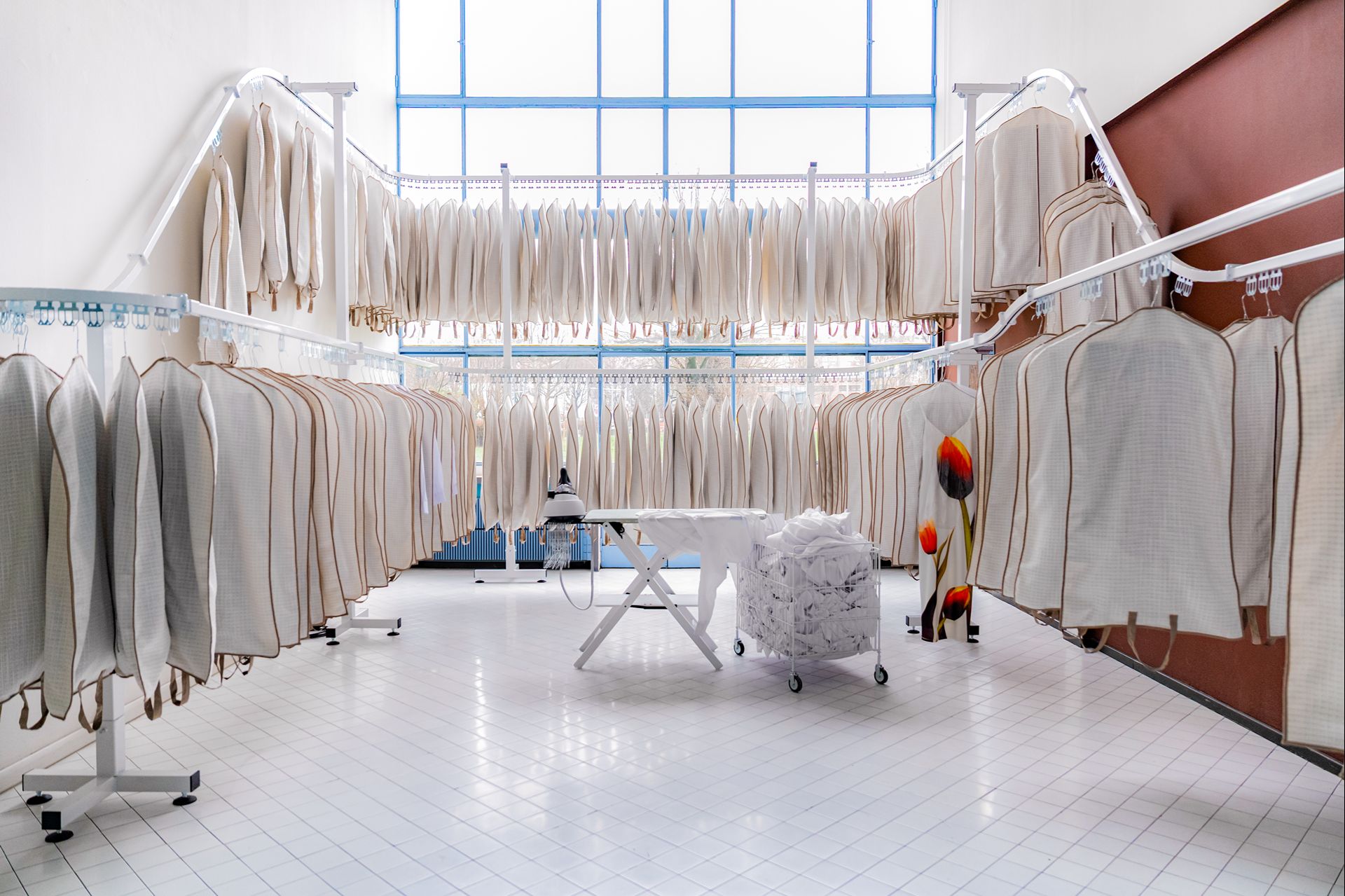
Wardrobe (2026) is a project conceived specifically for the Padiglione de l’Esprit Nouveau, and combines a site-specific architectural presentation with a performance by the artist in person. Inspired by the dual nature of the Padiglione – manifesto of modernist ideals and prototype of the Le Corbusier’s machine à habiter – Naamani creates an installation that transforms the building into a sort of large wardrobe in which she stages daily life through the act of ironing. A wardrobe refers not only to clothing, but also to the act of guarding, preserving, and conserving, and the word Wardrobe itself contains this dual meaning: starting from its etymology (from the French garde-robe, “guard” and “clothing”), Naamani has conceived a presentation that considers the concepts of habit/ habitation/ habitude and how the body, its shelter, and the repetition of gestures contribute to structuring our way of being.
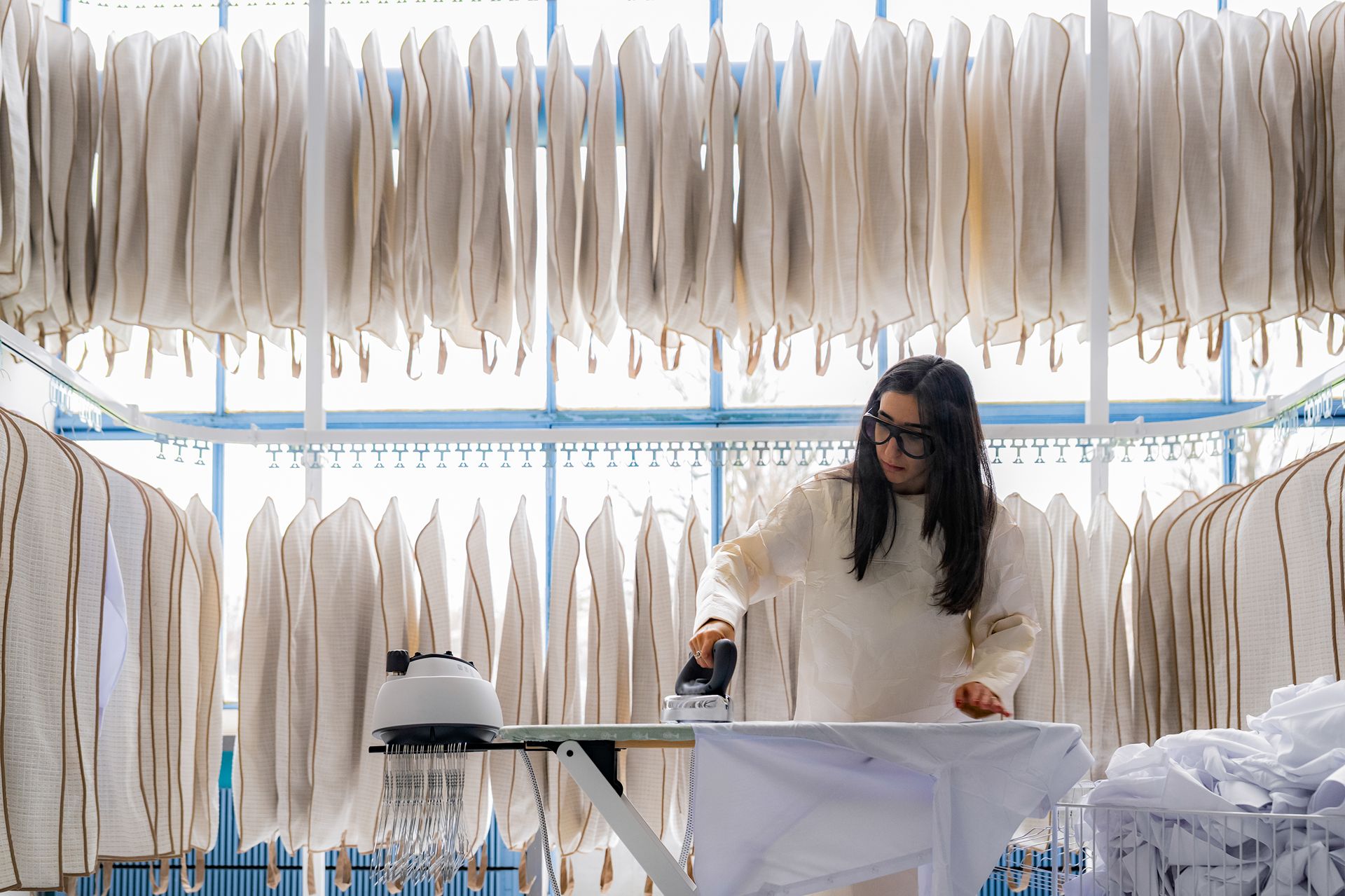
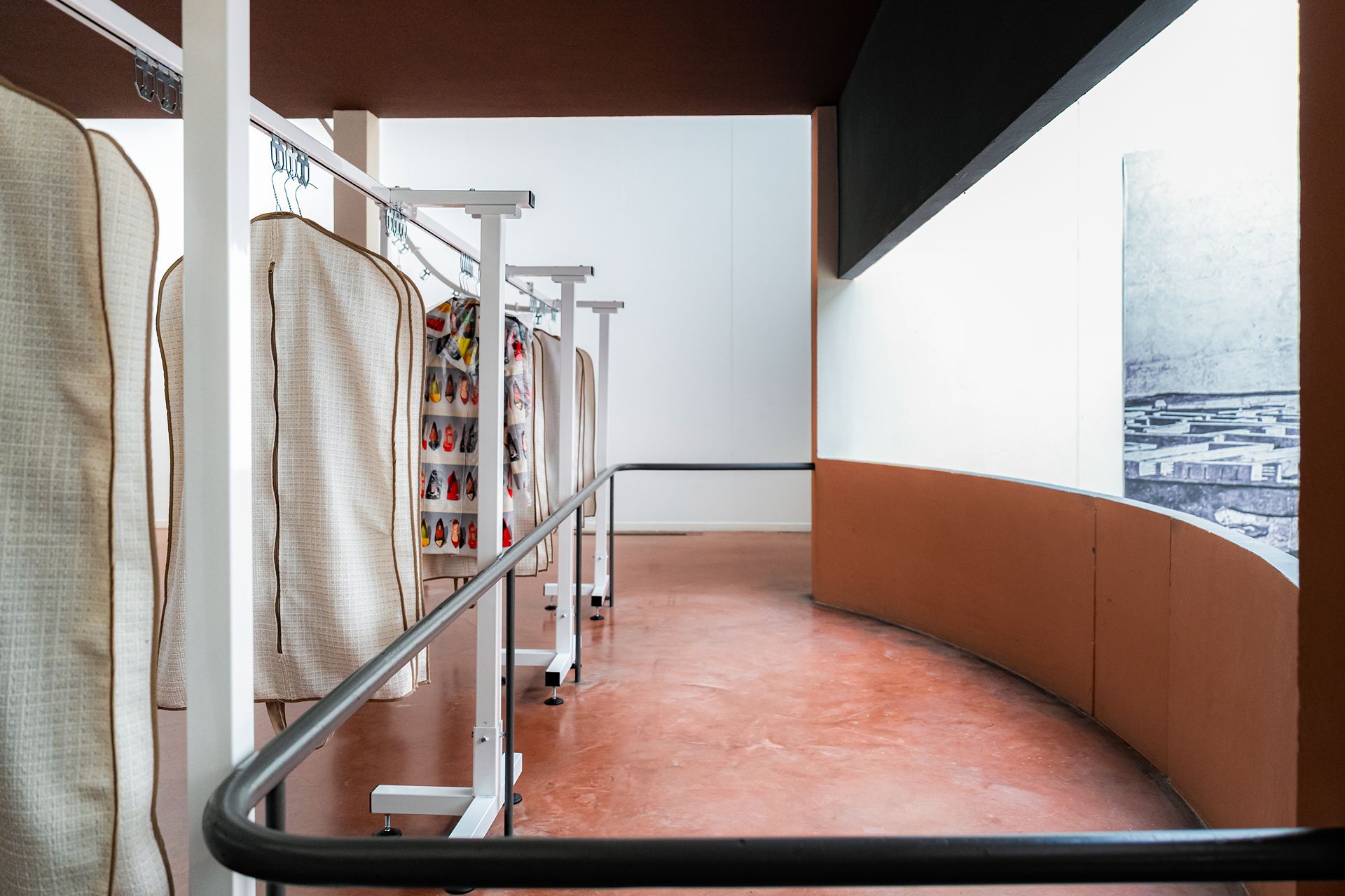
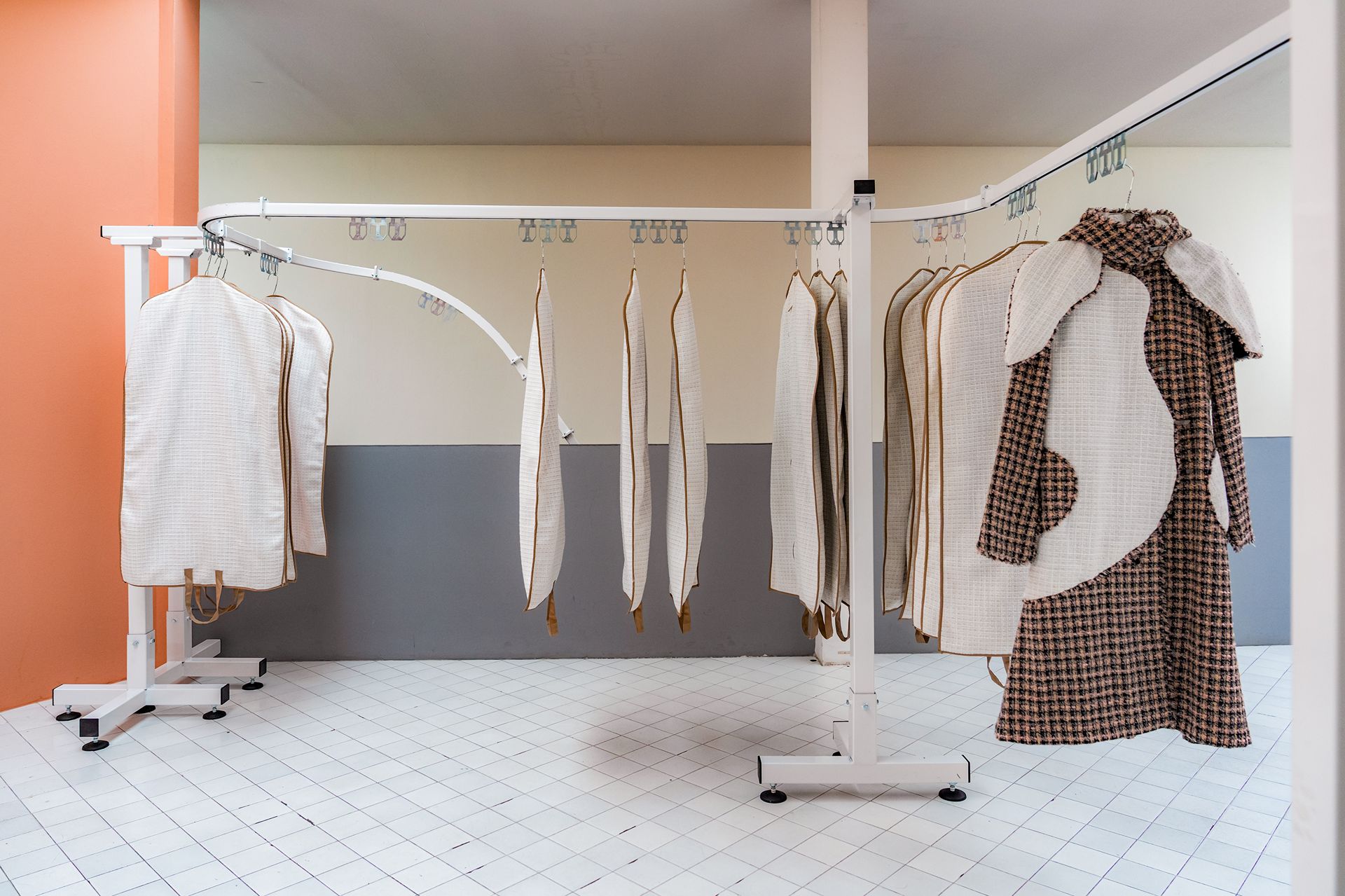
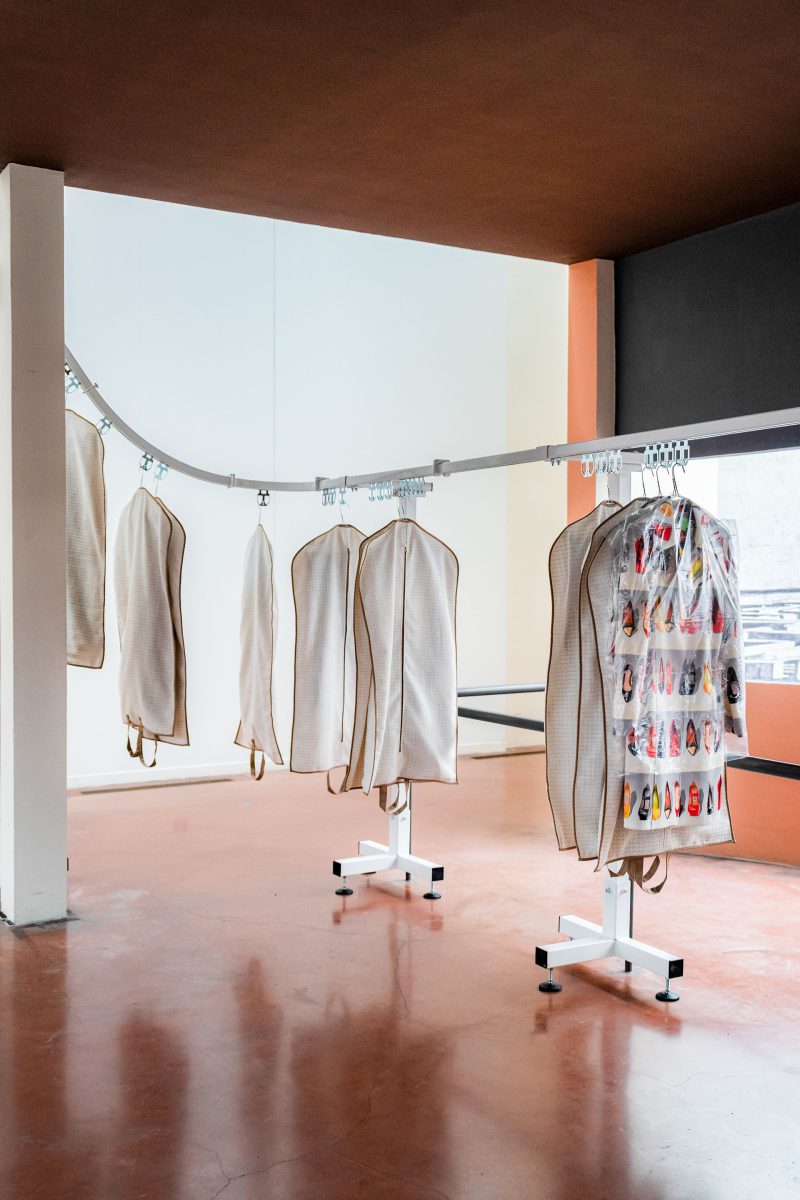
A garment conveyor rail – of the kind commonly used also in dry cleaners for hanging clothes – runs through the Padiglione, tracing a line that dialogs with the pure geometries of the building and leading to a room where numerous monochrome garment bags, identical and precisely hung, frame the performance site. For the first time, Naamani’s colorful garments are replaced by their coverings: If clothing is in itself an interface, a second skin, and an archive of the body, the garment bag emphasizes the idea of guarding, protection, and containment, becoming a meeting point between architecture and the body.
The eccentric fabrics that characterize her production are likewise signified in a completely different manner: stripped of every iconographic element so that the materiality, texture, and weave of the tweed replace the narrative intertwining created by the images, transformed into only apparently neutral surfaces. Although tweed transmits an appearance of neutrality by means of a reduced chromatic palette and absence of images, it remains a material deeply imbued with history and references linked to social class, tradition, duration, and protection. Historically, tweed is a sturdy fabric, designed to protect against the cold and wind, to be durable, and therefore relates directly with the concepts of cover, shelter, conservation, and care expressed in the entire project. Thus, the artist’s choice of this material is not decorative, but instead functional and symbolic: it physically embodies the idea of protecting the body and, by extension, of safeguarding memory and identity. At the same time, tweed is a fabric that is strongly identified with western culture, associated with respectability, normativity, and with a certain idea of social stability. Its historical link to elegance (Coco Chanel in particular made it an icon of emancipation and sophistication) adds a further level of meaning, and, in a context in which the body is absent, covered, or kept at a distance, creates a dissonance leading to a critical interpretation of protection, visibility, and control.
Nevertheless, in Naamani’s work, meanings are never unequivocal, but instead open, layered, and crossed by multiple narrations flowing simultaneously. In this case as well, the installation leads to further levels of interpretation that resonate with the dramatic events taking place in her home country, Iran. In light of the current repression, these garment bags take an unexpected significance: by evoking body bags, they give rise to images that pertain to our present, and their whiteness seems to offer a silent gesture of commemoration and homage. Faced with a heavily armed government, demonstrators are literally helpless, and the body represents the last line of defense, where resistance is no longer symbolic but instead a question of life or death: after years of silence, it has become the final shield. Likewise, the garment with the tulip print which we glimpse among the many garment bags, has a precise symbolic value linked to Iran, where the red tulip is a symbol of martyrdom, often associated with those who died for freedom.
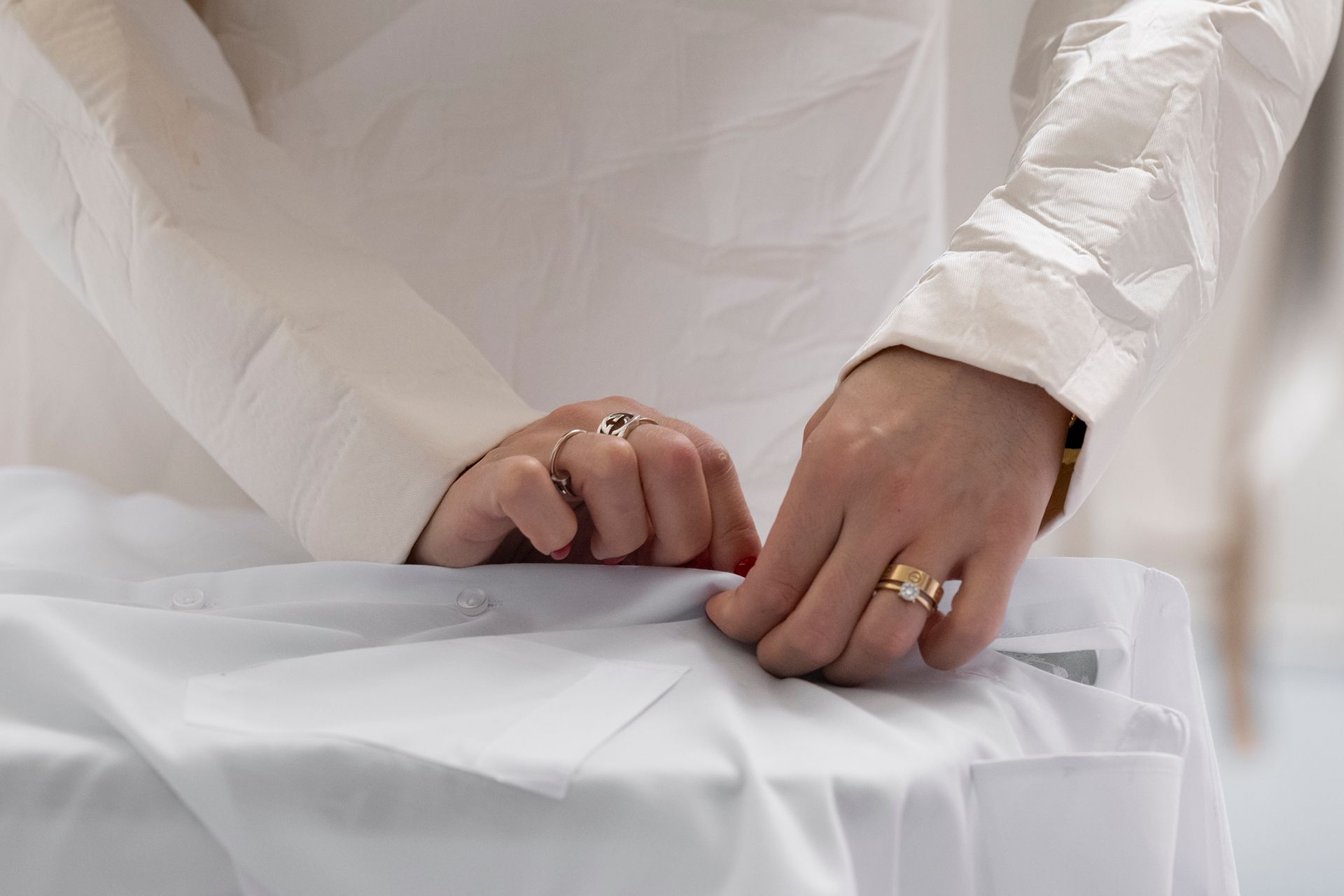
At the center of this extraordinary stage, the artist performs the simple act of ironing: a daily gesture that evokes care and dedication, but also mechanical repetition and alienation. References to this iconography are found in pop culture and in art history, from 17th-century Flemish and Dutch painting to the celebrated Ironers of Edgar Degas and Pablo Picasso, up to the feminist performances of the ‘70s and ‘80s. Contextualized in the Padiglione de l’Esprit Nouveau, this gesture reconnects directly to Le Corbusier’s vision of the house as a machine à habiter (a house is a machine for living), i.e., as a rational and efficient entity designed to satisfy the demands of everyday life. In its mechanical repetition, the act of ironing reflects the same functional logic embodied by modernist architecture: if the house is a machine, the body becomes an integral part, inserted in a system in which every element works in synergy to guarantee its operation. This act, which implies care, attention, and dedication, also highlights the physical and emotional aspects of living, showing that every functional space is crisscrossed by daily actions that constantly redefine its significance.
In this narrow margin between function and emotion, Wardrobe offers food for thought on living and on the dynamics that govern the relationship between body and architecture. By means of a simple and repeated gesture, Naamani transforms this domestic action into a critical device, revealing the ways in which the body becomes part of, adapts to, and renegotiates the spatial and functional systems of daily life.
Chalisée Naamani (b. 1995, Neuilly-sur-Seine, France) trained at the École Nationale Supérieure des Beaux-Arts in Paris, where she lives and works. She has held solo exhibitions at galleries and public institutions such as the Palais de Tokyo, Paris (2025); Pinacoteca Agnelli, Turin (2024); La Galerie, Noisy-le-Sec (2021); and Art-O-Rama, Marseille (2021). Her work has also been featured in numerous group shows in spaces such as Hangar Y, Meudon (2024); Nice Biennal, Nice (2022); Poush, Paris (2022); Reiffers Institute, Paris (2022); La Villette, Paris (2022); and BOZAR, Brussels (2022). She was awarded the Pista 500 Award of Pinacoteca Agnelli (2023), the Prix des Fondations for sculpture and installation (2021), and the Prix Benoît Doche de Laquintane (2021).
When
February 6-8, 2026
Performance Schedule:
Thursday, February 5 at 4 pm and 6 pm
Friday, February 6 at 12 pm and 6 pm
Saturday, February 7 at 12 pm, 4 pm, and 6 pm
Sunday, February 8 at 12 pm and 3 pm
Free admission, no reservation required
Where
Padiglione de l’Esprit Nouveau
Piazza della Costituzione 11
Bologna
Opening Hours of the Padiglione de l’Esprit Nouveau:
Thursday, February 5: 3 pm – 8 pm
Friday, February 6: 11 am – 8 pm
Saturday, February 7: 11 am – 8 pm
Sunday, February 8: 11 am – 6 pm
Photo credit
Chalisée Naamani,
Wardrobe, Padiglione de l'Esprit Nouveau, Bologna, 2026.
A project by Arte Fiera in collaboration with Fondazione Furla.
Courtesy the artist and Ciaccia Levi (Paris -Milan).
Ph credits Team99.